
His business idea began with a rude awakening
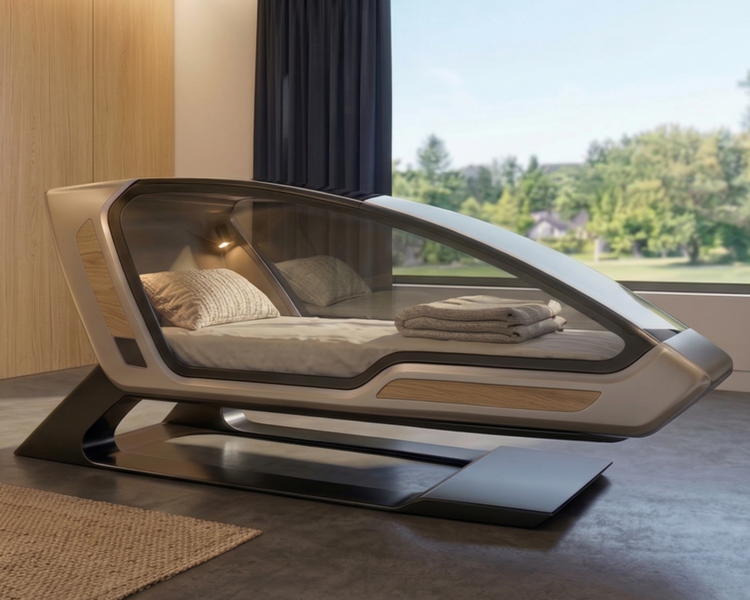
French engineering student Titouan Stephan is such a light sleeper that almost anything can disturb his night's sleep. Now, he wants to develop a sleep pod capable of controlling everything from temperature and humidity to light and noise.

The coffee machine is clearly bored on this sluggish summer day at Kitchen, with most entrepreneurs and staff away on holiday.
Titouan Stephan should probably be taking some time off too.
The 20-year-old Frenchman is halfway through a four-month internship at Aarhus University, where he has been given the opportunity to dedicate himself fully to a business idea before returning to engineering school in Bordeaux in mid-September to continue its development.
By then, Titouan Stephan hopes to have progressed far enough with the technology for his distinctive sleep pod to be able to turn his attention to the design.
But squeezing a lot of electronics into a compact, streamlined product capable of controlling everything from temperature and humidity to light and noise – without humming or vibrating – is such a complex task that the dark-haired entrepreneur is working almost constantly.
That is why he is immersed in his computer even though it is 14 July – Bastille Day – and the city's bars, decked out in the French tricolour, are probably packed with compatriots gearing up for the evening's World Cup semi-final between Les Bleus and Spain.
"Most sleep capsules are very analogue. I'm trying to create a more advanced product because there is nothing like it on the market today," explains Titouan Stephan, who struggles with poor sleep himself.
When the temperature at night rises above 20 degrees, he tosses and turns constantly. The same happens when the humidity is high, when light disrupts the darkness or when the peace and quiet is broken by noise.
"My sleep is disturbed by all sorts of things, actually."
An overlooked public health problem
The challenge is not confined to the bedroom. When Titouan Stephan arrives at university after a restless night, he quickly notices that his ability to concentrate does not last throughout the day.
According to estimates from the National Institutes of Health, around one in ten people worldwide are thought to suffer from the same problem, with the organisation even describing sleep apnoea as an overlooked public health problem.
So far, this has resulted in a wealth of solutions from a multitude of suppliers: sleeping pills, weighted blankets, earplugs, blackout curtains, air conditioning, specialist mattresses and much more. But Titouan Stephan has now set out to bring everything together in a single product: a state-of-the-art sleep pod with a design sleek enough to fit into any home.
The idea came from major airport terminals in Asia, where it is not unusual for tired passengers to pay for access to a sleep pod equipped with a bed, air conditioning and Wi-Fi.
"Sleep is one of the most important factors in maintaining good health," says Titouan Stephan, pointing out that longevity and biohacking – optimising our bodies and minds – appear to be emerging as a megatrend.
After settling on the idea of a sleep capsule, he attended a health fair to find inspiration within the field of sleep. There, he came across bulky relaxation furniture designed to reduce stress.
"It made me think that people might be ready to install a sleep pod in their homes. It may sound very sci-fi, but I think the product could win people over quite quickly," says Titouan Stephan.
Helping athletes and top executives
He originally considered developing a sleep pod for two people, but his market analysis showed that customers prefer to sleep on their own so they can adjust the capsule to their individual needs and achieve better-quality sleep.
This makes sense given that the product is initially aimed primarily at high-performance individuals such as athletes and top executives who are prepared to pay a premium to improve the quality of their sleep.
The market may therefore be relatively narrow at first, but Titouan Stephan expects it to expand fairly quickly, as is often the case when new technologies make their way into our everyday lives.
The young entrepreneur chose to apply for an internship 1,800 kilometres north of his home region because he had heard about the entrepreneurial culture at Aarhus University. He also expected Denmark to place greater emphasis on physical and mental well-being than many other countries.
Both have lived up to his expectations. Overall, Titouan Stephan has enjoyed his time in Denmark and working with the business developers at Kitchen.
"It's also been great to talk about the project with the other entrepreneurs here, even though they're working in completely different fields," says Titouan Stephan, who attended the SMIL startup festival shortly after arriving in May to meet other entrepreneurs in Aarhus.
The internship has also brought an unexpected benefit: he has slept better during the summer because temperatures and humidity levels are considerably lower in Denmark than in France.
"On the other hand, it's been difficult to get used to the light evenings. I need to sleep in a dark room, but the curtains in my apartment are pretty transparent," says Titouan Stephan, acknowledging just how sensitive a sleeper he is.
It has frustrated him for years. But perhaps there is a promising business in it after all.