
Menglin wants to restore sight with a ‘solar cell’ in the eye
It is invisible to the human eye, but may one day help us see again. Associate Professor Menglin Chen is developing a nanoparticle with remarkable potential.

The mere thought of having a needle inserted into your eye is enough to send a shiver down your spine.
Nevertheless, it is a key part of the solution that Menglin Chen, Associate Professor at the Department of Biological and Chemical Engineering at Aarhus University, hopes could one day help people who have partially or completely lost their sight due to retinal diseases.
And the solution? Well, it has been given the name RetiNano, and you will find it at the tip of the needle: a nanoparticle around 200 times smaller than the thickness of a human hair – and, somewhat ironically, impossible to see with the human eye. Healthy retina or not.
A nanoparticle that, in very simple terms, is designed to work a little like a solar cell.
A new light sensor in the eye
To understand why we might need a “solar cell” inside the eye in the first place, we need to take a short journey into the eye and all the way to what we know as the retina.
Among other things, the retina contains so-called photoreceptors. These cells detect light and form the first link in the chain of signals that eventually reaches the brain and becomes what we see.
But in several well-known eye diseases, such as age-related macular degeneration, photoreceptors can become damaged – and in the worst cases, die. And even if large parts of the rest of the eye are still functioning, the first signal in the chain is missing. Much like an old string of Christmas lights with a broken link in the chain, vision can become severely impaired – and with some diseases, in the worst case, be lost altogether.
This is where Menglin Chen’s nanoparticles come into the picture.
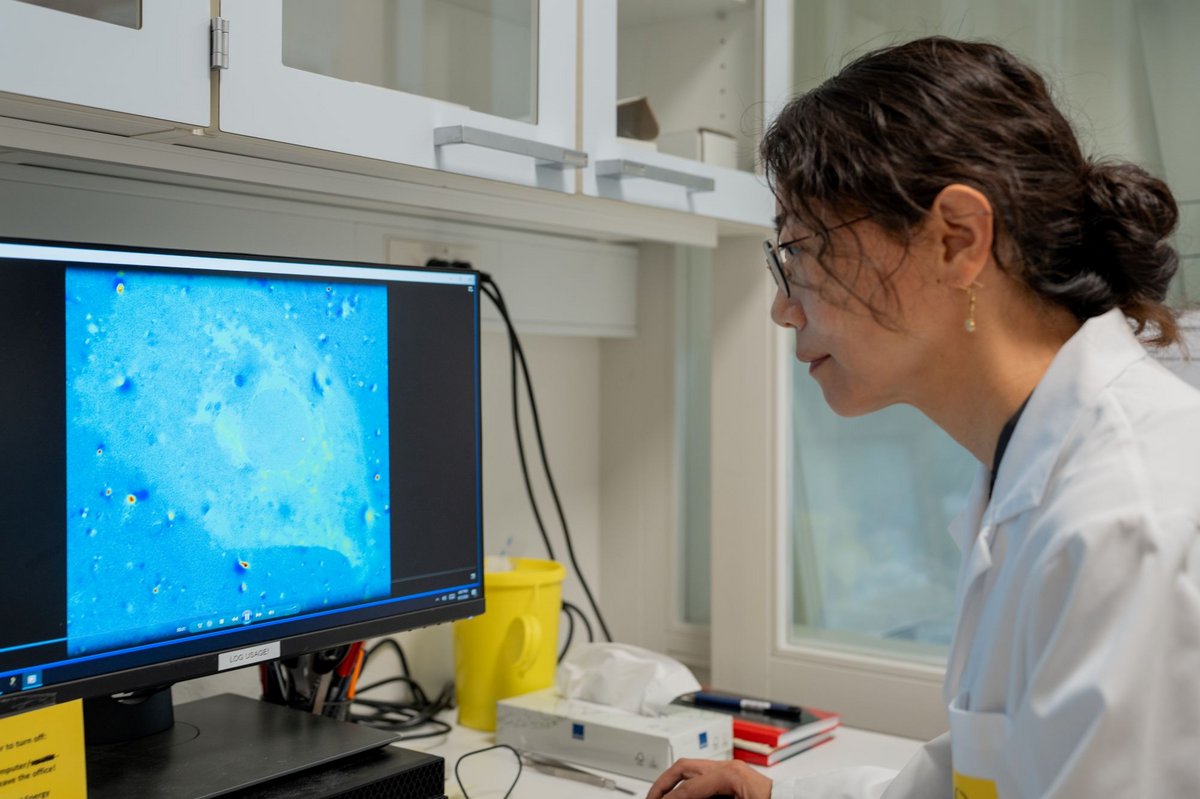
The idea is for them to act as artificial photoreceptors. They are injected into the eye, where they are intended to settle close to the retina and take over the function of receptors that no longer work. Here, they convert the light they detect into energy that can help restart the chain of signals that has otherwise been broken.
A kind of solar cell disguised as a nanoparticle, Menglin explains.
“In very simple terms, the nanoparticle works a little like a solar cell. It captures light and converts the energy so that the remaining cells in the retina can once again pass the signal on towards the brain.”
7 years… and counting
A solution like the one Menglin Chen and her research group are working on does not happen overnight. Or even over the course of a year, for that matter.
Back in 2019, Menglin received a DKK 4.2 million grant from the Carlsberg Foundation. It marked the beginning of the work on light-sensitive nanomaterials – and the first step towards a solution that might one day be used to help people with vision loss.
In 2024, the researchers filed an international patent application for the technology, and in 2025 Menglin also received a Pioneer Innovator Grant for the project, entitled RetiNano: Biocompatible and injectable photovoltaic retinal prosthesis.
So when will the solution actually be launched and made available?
Menglin urges patience. Because although the researchers have already taken some important steps, there is still a long way to go before a doctor will be reaching into a drawer for a syringe filled with the nanoparticles.
“We have carried out experiments on blind mice where, after injecting RetiNano, we were able to measure activity in the brain in response to light. But even though that is promising and a major step in the right direction, we are still at an early stage. Among other things, we now need to document the effect and safety over a longer period before we can even begin to talk about clinical trials in humans.”
Driven by curiosity
The road to Aarhus and the work on RetiNano have, in many ways, been shaped by the same thing that still drives Menglin today: curiosity.
She grew up in China and developed a strong interest in the natural sciences from an early age. When the time came to choose a direction at university, the choice stood between chemistry and medicine.
She chose chemistry, but her fascination with the human body, health and medicine never entirely disappeared.
“I am driven by curiosity. The more you learn, the more you realise how much you do not know. To me, that is exactly what makes research exciting – constantly being able to explore something new and not overlook unexpected results.”
Menglin Chen’s curiosity also took her beyond China’s borders, initially setting her sights on the United States. But the SARS outbreak in the early 2000s made it difficult to enter the country, bringing the American adventure to an abrupt end before it had even begun.
Instead, she was given the opportunity to continue her education in the Netherlands. And that turned out to be a good match. In more ways than one.
It was in the laboratory that she met her future husband, who was a PhD student in Aarhus at the time. And when Menglin later had the opportunity to continue her own research in Aarhus, she followed him to Denmark.
That was 21 years ago.
Aarhus has been her base ever since, and along the way chemistry has been mixed with nanotechnology, biology and medicine – disciplines that, in many ways, bring together the interests she already had back in her childhood and which are now combined in RetiNano.
“Interdisciplinary research is absolutely essential. There is no sharp boundary between physics, chemistry, biology and health. We bring different perspectives to the table, which means we also see different solutions and opportunities.”
And although the ultimate dream for RetiNano is for the technology to one day help people regain their sight, that is not what Menglin points to as her primary motivation.
It is curiosity.
“Of course, it would be amazing if RetiNano could one day help patients regain their sight, but first and foremost, it is curiosity that drives me – and helps me discover new possibilities, which in the long run will provide a stronger foundation for innovations that ultimately benefit patients.”