
“We must dare to venture into the unknown”
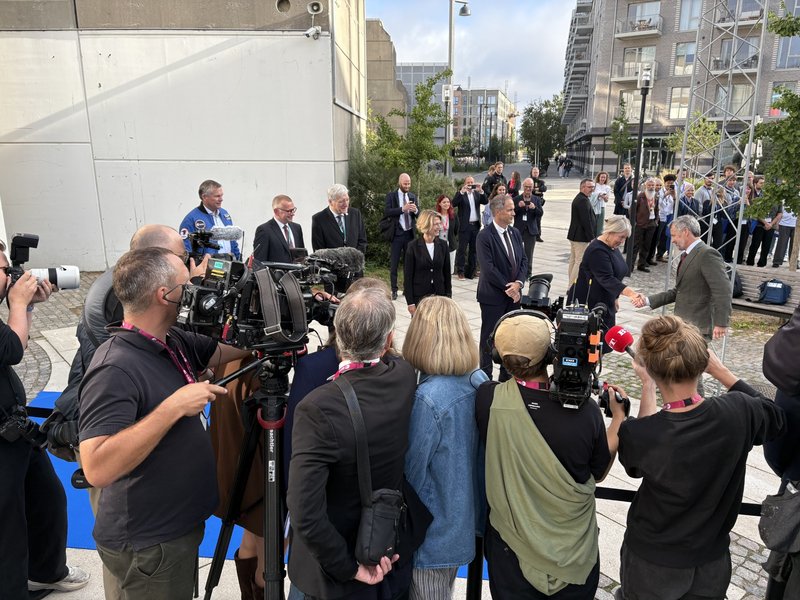
King Frederik had to leave the “Space for Inspiration” conference before he made it to the stage. In doing so, he inadvertently helped underscore the organisers’ key message.

When Christina Egelund gave her speech one final read-through before arriving at the space conference, the minister could hardly have imagined just how fitting her words would prove for a morning in which the opening programme had to be changed at short notice.
“We must dare to venture into the unknown, even though we cannot foresee every challenge – because that is precisely what makes it so exciting,” Christina Egelund said in her speech at “Space for Inspiration”.
The Minister for Higher Education and Science then returned to her seat in the front row, where King Frederik was scheduled to be sitting beside her, ready to be called onto the stage to receive a flag.
But the King was not there.
Half an hour earlier, he had been forced to leave the conference midway through the official welcome because a series of demonstrations across Copenhagen threatened to delay him on his way to his next engagement – a funeral.
As a result, the opening of the space conference had been changed at the last minute, the flag had been put away, there was a sense of confusion among the hundreds of participants from around the world – and Christina Egelund could hardly have asked for a more fitting setting for her speech.
The minister reminded the audience that exploring space is much like Odysseus’ long journey home from Troy: we cannot foresee every challenge we will face over the next 20 years – or, for that matter, the next 20 minutes, as the opening of the conference had just demonstrated.
26 unsuccessful attempts to make contact
The analogy was elegantly picked up by Aarhus University’s Director of Enterprise and Innovation, Lone Ryg Olsen, who was the next keynote speaker to take the stage at Bella Center.
She entertained the audience of business leaders, investors, researchers, entrepreneurs, policymakers, advisers and bridge-builders of every kind with the story of DISCO, a national student programme designed to develop a new generation of space technology specialists and maintain Denmark’s leading position in nanosatellites.
Led by Associate Professor Christoffer Karoff, DISCO launched a satellite into orbit this spring on a mission to photograph glaciers and measure temperature differences in the waters around Greenland’s fjords using two optical cameras and one infrared camera. The launch prompted both DR and TV 2 to send reporters to Aarhus University, where current and former students from the programme gathered to watch the live transmission from California.
“Can you imagine the deafening cheers as the rocket lifted off, trailing a column of fire behind it? Can you picture the confetti cannons going off? And can you imagine the deafening silence when the control room was later unable to establish contact with the satellite?” Lone Ryg Olsen asked.
It was not until the following morning – and after another 26 unsuccessful attempts – that contact was finally established with the small satellite, the director explained. The story reinforced both the minister’s message and the wider theme of the conference: Denmark and Europe must not be afraid to experiment as they seek to improve their ability to explore space for new business opportunities and groundbreaking solutions.
Better than diamonds
Inspiration to explore beyond our own atmosphere could be found everywhere at the two-day conference, which focused on four areas: health technology, construction materials, food production and space resources.
One of the stands in the exhibition area was hosted by Danish Graphene, an Aarhus University spinout that has developed a method for producing the wonder material graphene, which conducts electricity better than copper and heat better than diamonds.
Through a collaboration with the European Space Agency – which hosted the conference together with the Danish Ministry of Higher Education and Science – Danish Graphene has used space as a kind of laboratory to test the material’s properties under extreme conditions.
The work has led to a breakthrough in the use of graphene here on Earth, company co-founder Andreas Brunsgaard Laursen explained when the King and the welcome committee stopped by the stand, shortly before the remainder of the planned opening programme had to be changed.
The confusion was short-lived, however. The opening speeches were followed by a packed programme of on-stage interviews, workshops and opportunities to mingle with a wide range of key players.
“Let’s do something together”
Among the speakers was Rasmus Munk, head chef and co-owner of the Michelin-starred restaurant Alchemist. In his efforts to experiment with new taste experiences and develop more sustainable ingredients, he has teamed up with gastrophysicists from the University of Copenhagen.
So far, the collaboration has resulted in 15 scientific papers.
“From the very beginning, Alchemist’s overall ambition has been to create new solutions within food and biotech,” said Rasmus Munk, who has since launched the innovation centre Spora and become involved in the Novo Nordisk Foundation’s work to turn CO2 into sources of protein.
And space?
Alchemist is ready to venture there too in its pursuit of new discoveries, the chef assured the audience.
That idea was immediately seized upon by another prominent speaker on stage, French entrepreneur Nicolas Gaume, who has sent both bottles of wine and vine cuttings to the International Space Station as part of an experiment aimed at developing stronger, more resilient crops for agriculture.
“Let’s do something together,” Nicolas Gaume said, addressing Rasmus Munk directly.
Perhaps something will come of it, perhaps not. Either way, the conference certainly created a space full of inspiration.